TyT Tecnología
Website, product catalog and admin dashboard for a tech repair and security camera shop. Sole developer.
In short
- Sole developer, from the first requirements to deployment
- WhatsApp checkout and an admin dashboard the owners run themselves
- 119 test files in CI; images moved to Cloudflare R2 by swapping one adapter
- Role
- Sole developer: requirements, design, development, testing, deployment and support
- Period
- Jul 2026 – Present
- Team
- Sole developer, part-time
- Status
- Live
- Stack
- Next.js 16, React 19, TypeScript, Prisma, PostgreSQL, Auth.js, next-intl, TanStack Query, Zustand, Zod, Tailwind CSS, Cloudflare R2, Gemini, Vitest, Playwright, GitHub Actions, Docker
- Links
- Visit the live site
The code is private, so this case study describes the work instead of linking to it.
The problem
TyT Tecnología repairs computers, installs security cameras and sells equipment in Pérez Zeledón. It had no place of its own on the web: nothing that showed up when someone searched for the shop, nowhere to see its services, and no catalog to browse.
Three constraints shaped the project:
- People buy over WhatsApp. The shop’s customers already close every sale in a chat, so the site had to hand them over to WhatsApp, not replace it with a payment gateway.
- The owners keep it up to date. Products, prices, photos, services and promotions change often, and none of that could depend on a developer.
- Prices in colones, with a dollar reference. Equipment is often priced against the dollar, so the site shows both, with an exchange rate that updates itself.
What I built
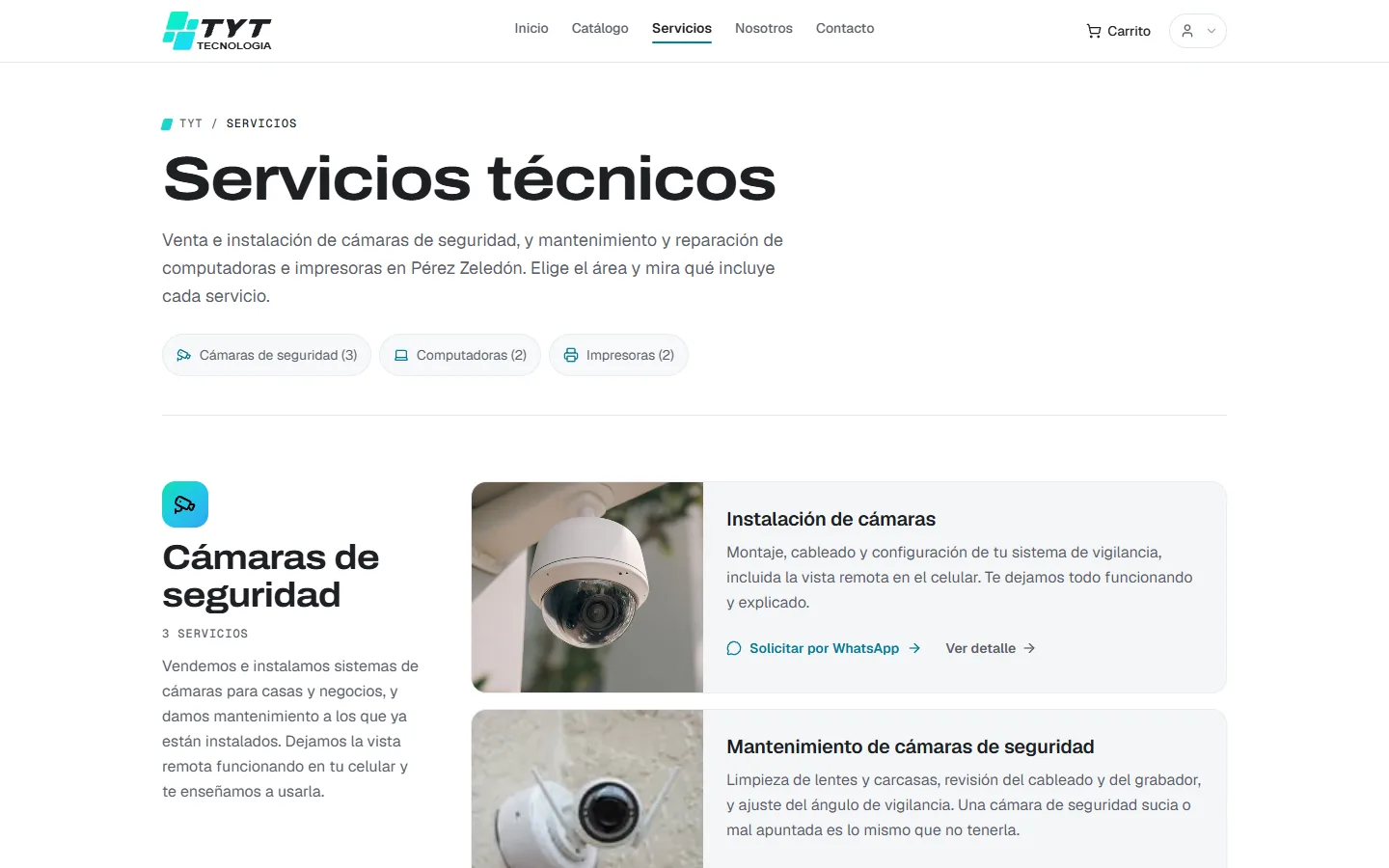
- Public site in Spanish and English: a services landing page with one page per service, a catalog with filters and category pages, product pages, success stories, contact with a map, and legal pages.
- Cart with WhatsApp checkout. The cart lives in the browser and, once the customer signs in, in their account; the two merge without losing items. Checkout turns the cart into a WhatsApp message to the shop.
- Customer accounts with inquiries handled as message threads, so a customer can choose between the web and WhatsApp.
- Admin dashboard for products and photos, services, categories, success stories, inquiries and site settings (WhatsApp number, hours, location, social links), so nothing the owners need to change is hard-coded.
- Daily exchange rate: a scheduled job updates it, and every price shows in colones with its dollar reference.
- AI-assisted product entry: the admin pastes a product sheet from another store and Gemini fills in the form for review.
- Promotions for social media, described below.
- Technical SEO: per-page metadata,
hreflang, a sitemap, structured data and statically generated pages.
Technical decisions
Ports and adapters
The domain defines interfaces and knows nothing about the database or outside services. WhatsApp, file storage and the exchange-rate source are adapters behind those interfaces.
That paid off when product images moved from Vercel Blob to Cloudflare R2: the code change was one new adapter, with no edits to the business logic, plus a one-off copy of the existing images.
- File storageCloudflare R2Replaced Vercel Blob by swapping this adapter
- CheckoutWhatsApp message
- Exchange rateDaily rate source
- DataPrisma and PostgreSQL
A visual identity without a photo shoot
The shop had a logo and nothing else: no professional photography, no illustrations, no brand guide. Stock photos would have made it look like any other store, so the design is built from what the brand does have:
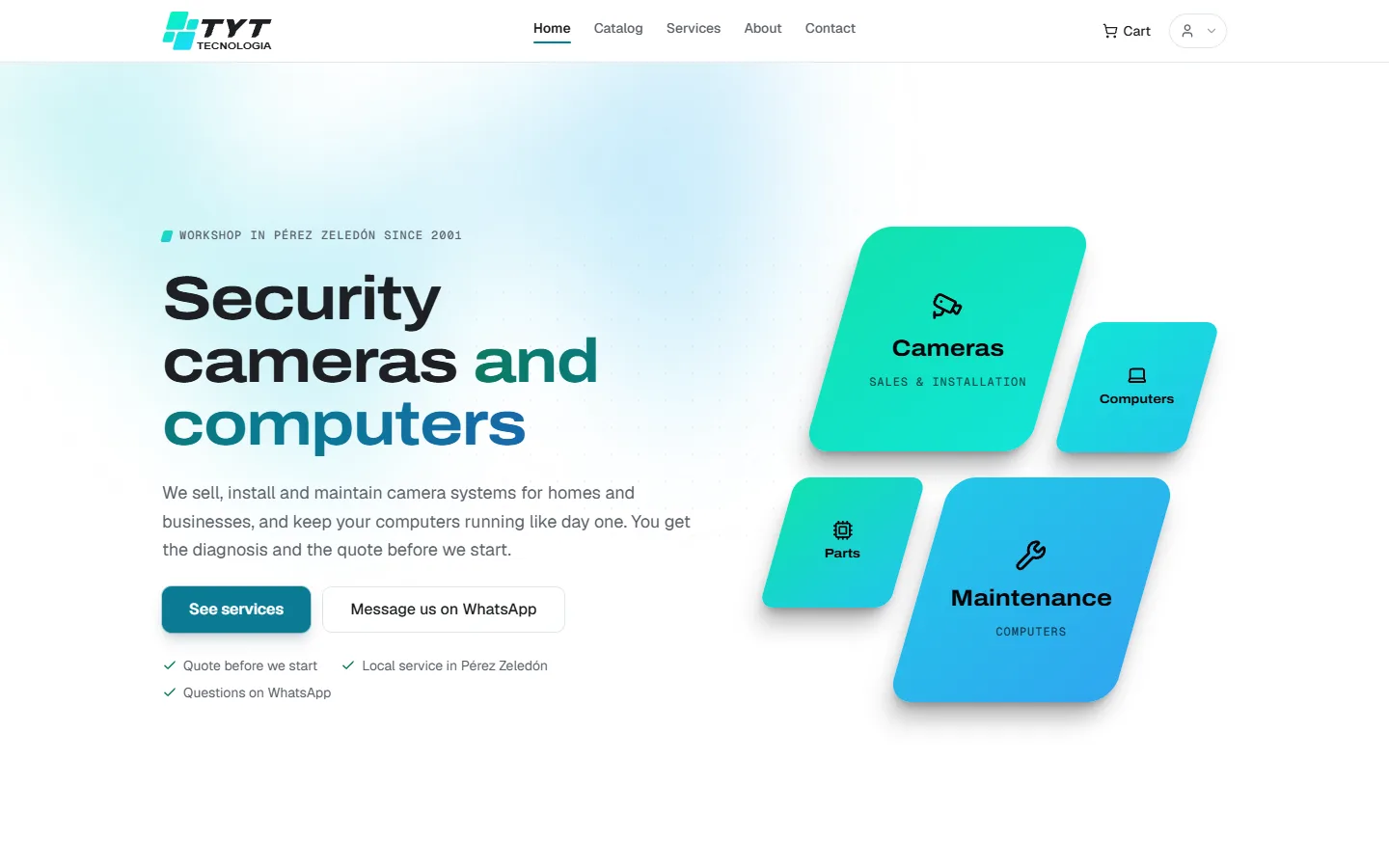
- The home hero is built from TyT’s own isotype, and its shapes carry down the whole home page instead of a generic banner image.
- The workshop ticket as the design language. Product, service and contact cards look like repair tickets, with a reference code and a tear-off cut, and product specs read like a data sheet.
- A type system instead of imagery: an expanded typeface for headings, a neutral one for body text and a monospace for workshop data such as codes, specs and labels, on a dark palette where one color is reserved for actions and another for status.
- Consistent product photos: AI puts the shop’s own photos on the same studio background (see the next section), so the catalog looks like one collection.

AI that drafts, a person who approves
Promotions are where AI helps the most and can hurt the most, because a wrong price on a flyer is a promise to a customer. So the flow splits the work:
- The admin picks a product.
- Gemini prepares studio-style photos and the promotional copy.
- The admin reviews photo by photo and approves or discards each one.
- The code draws the flyer, in 4:5 and 9:16 for social media, with the price and details taken from the database.
Nothing is published without approval, and the model never writes a price.
Authorization on every action
Every admin screen and every server action checks the administrator role itself. The routing layer also blocks non-admins, but it is not the only lock: if a request reaches an action some other way, the action still refuses it.
Quality that runs on its own
- 119 test files: 105 unit test files with Vitest and 14 end-to-end with Playwright, about 635 tests.
- CI on every push: lint, formatting, tests, build and end-to-end.
developfor daily work andmainfor releases, merged by pull request, with a preview deployment for every branch.- Handoff notes, a roadmap and a QA checklist for every deploy, so someone else can pick the project up.
Result
- Live at tytsoluciones.net, bilingual, on the shop’s own domain.
- Built so the owners manage the catalog, services and promotions from the dashboard, without a developer.
- 19 data models and 119 test files, by one developer, in about five months.
- The app is containerized, and a move to self-managed infrastructure to lower hosting costs is in progress.
What I took from it
The hardest part was not the code: it was making a small shop look established with no professional assets, just a logo and a clear idea of how the workshop works. A design system built from the brand’s own shapes and type held up better than stock images would have, and it scales as the catalog grows.